
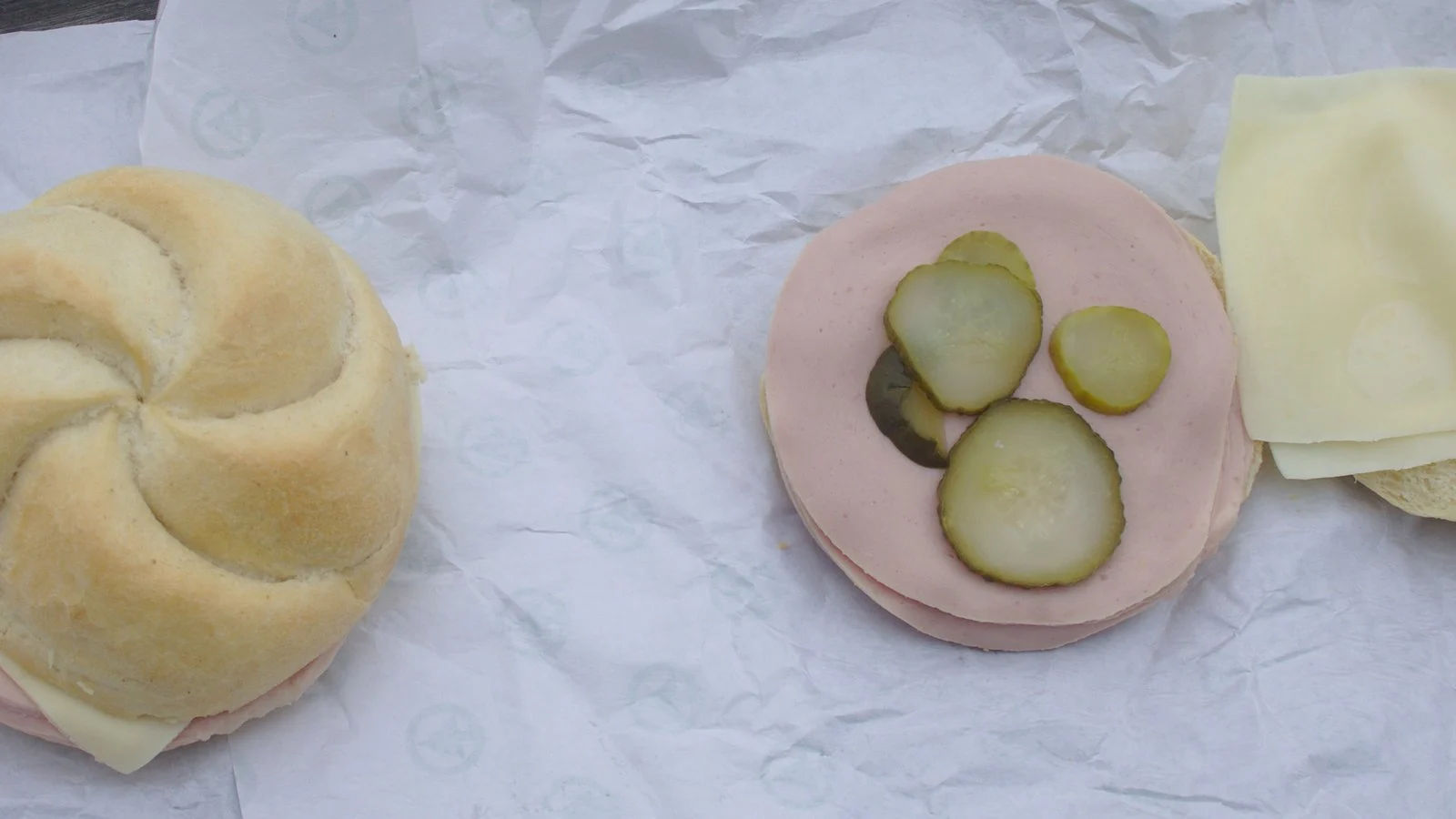
On almost any Viennese breakfast table you'll find a round roll with a five-petal pinwheel pattern on top, a crisp crust and a light, airy crumb: the Kaisersemmel. The German name means 'the emperor's roll,' and in English it's known as the Kaiser roll. Here's where the name comes from, why the star pattern looks the way it does, and how to get close to it in your own kitchen.
Why 'the emperor's roll'?
The Kaisersemmel goes back to 18th-century Vienna, and the ‘Kaiser’ (emperor) in its name is generally said to honour the Habsburg rulers of the time. A painting by court artist Martin van Meytens from around 1760–1770 shows the rolls on a festive table at Schönbrunn Palace, so they were already served at the court of Maria Theresa.
You’ll often read that the roll was shaped like a crown to honour Emperor Franz Joseph I (reigned 1848–1916). The timeline doesn’t fit, though: the word ‘Kaisersemmel’ appears in print by 1825, well before his reign. The name points to Habsburg prestige in general rather than one specific emperor. A telling detail: in 1789 the bakers’ guild petitioned Emperor Joseph II to exempt these rolls from strict price-and-weight rules, arguing the craft deserved freedom — and won.
The five-fold star isn't just decoration
The pinwheel on top is what makes a Kaisersemmel instantly recognisable — five curved segments radiating from the centre like overlapping petals. The dough itself is plain (white flour, yeast, malt, water, salt), so the pattern defines its character.
Crucially, the star is functional. Folding or cutting the pattern builds tension in the dough’s surface, so it rises evenly in the oven — giving that light interior and crisp crust. In Austria the roll is even defined in the national food codex (B18), with traits like the five-segment star and a minimum weight, so a sloppy imitation can’t claim the name.
Hand-folded or stamped
There are two ways to make the star. The traditional method is hand-folding: flatten the round dough, place a thumb at the centre, fold the dough over it, press, then rotate and repeat — tucking the fifth fold into the centre to form the crown. It takes skill, and artisan bakeries treat it as a mark of the real thing.
The faster method is a metal ‘Kaiser stamp’ pressed into the dough, common in larger bakeries. The results look similar, though hand-folding is often said to give more depth.